


If you're hoping to earn a bit more without taking on too much risk, short term bond funds could be a strong option. They invest in government and corporate bonds that mature within a few years, which means your money isn’t exposed to wild market changes. It’s like taking a quick pit stop to refuel, steady income without sacrificing safety.
This approach helps you balance modest earnings with the flexibility you need in your investments. If you're looking for a smart and steady way to boost your income while keeping your portfolio secure, these funds might be just right for your plan.
Understanding Short-Term Bond Funds: Definition and Purpose
Short-term bond funds are basically mutual funds or ETFs that focus on government and corporate bonds maturing in under five years. They’re built to keep your money safe while still offering regular income. By keeping the bonds short-term, these funds naturally dodge the big swings you might see with longer-term investments.
Most of the bonds in these funds mature within a few years. This short duration means they’re less affected by sudden changes in interest rates, unlike long-term bonds that lock you into a rate for many years. For example, imagine a fund holding bonds that mature in two to three years, it can quickly take advantage of new, better market rates.
If you have financial goals for the next three to five years, short-term bond funds might be a great match. When interest rates climb, these bonds can be reinvested at higher yields sooner, and if rates fall, they still help protect your original investment. In short, they offer a balanced mix of steady income and principal safety without the extra risks that come with longer-duration bonds.
Short Term Bond Funds: Safe Return Advantage

Short term bond funds help you keep your money safe while earning a little extra interest. They invest in bonds that mature in less than a year, kind of like taking a quick pit stop on your financial journey where you refuel without slowing down.
By sticking with short-duration bonds, these funds limit how much changes in interest rates affect you. Sure, the market might cause a few small ripples, imagine gentle waves on a calm pond, but overall, your investment remains steady.
If you need quick access to your money and want a yield that beats a typical savings account, short term bond funds can be a smart addition to your portfolio. They offer a balance between keeping your capital secure and earning a modest income.
- Provides high liquidity so you can get to your cash quickly
- Offers modest yields that are generally higher than those from a typical cash account
- Reduces the impact of interest-rate changes due to their short bond maturities
- Can experience minor shifts from market changes, such as small credit spread adjustments
- Strikes a balance between preserving your capital and generating a steady stream of income
Performance Metrics and Fund Examples in Short-Term Bond Funds
Short-term bond funds are designed to steadily boost your yield beyond what regular cash or money-market options offer. They work by reinvesting maturing bonds quickly into new opportunities, helping you enjoy a smooth, low-risk income stream without locking up your cash. If you're after consistent returns without unnecessary ups and downs, these funds might be just what you need. For example, many focus on parts of the corporate bond market that have short maturity periods, capturing small yield gains as market rates change.
| Fund | Index Tracked | Maturity Range |
|---|---|---|
| SPDR Portfolio Short-Term Corporate Bond ETF (SPSB) | Bloomberg U.S. 1-3 Year Corporate Bond Index | 1-3 years |
| iShares 1-5 Year Investment Grade Corporate Bond ETF (IGSB) | Investment Grade Corporate Bond Index | 1-5 years |
| Schwab 1-5 Year Corporate Bond ETF (SCHJ) | Short-Term U.S. Corporate Bond Index | 1-5 years |
| Vanguard Short-Term Bond ETF (BSV) | Market-Weighted Bond Index | 1-5 years |
| Fidelity Short-Term Bond Fund (FSHBX) | High-Quality Debt Index | Approximately 3 years |
This table shows funds that each hone in on different slices of the short-term bond market. What ties them together is their goal to offer better yields than simple cash options, using a mix of benchmark indices and maturity ranges to keep your income steady while risk stays low. If you've ever used a mutual fund calculator, you'll appreciate how comparing these metrics can give you clear insights into potential yield improvements, making it easier to decide which option fits your financial needs.
Comparing Short-Term Bond Funds with Other Debt Instruments
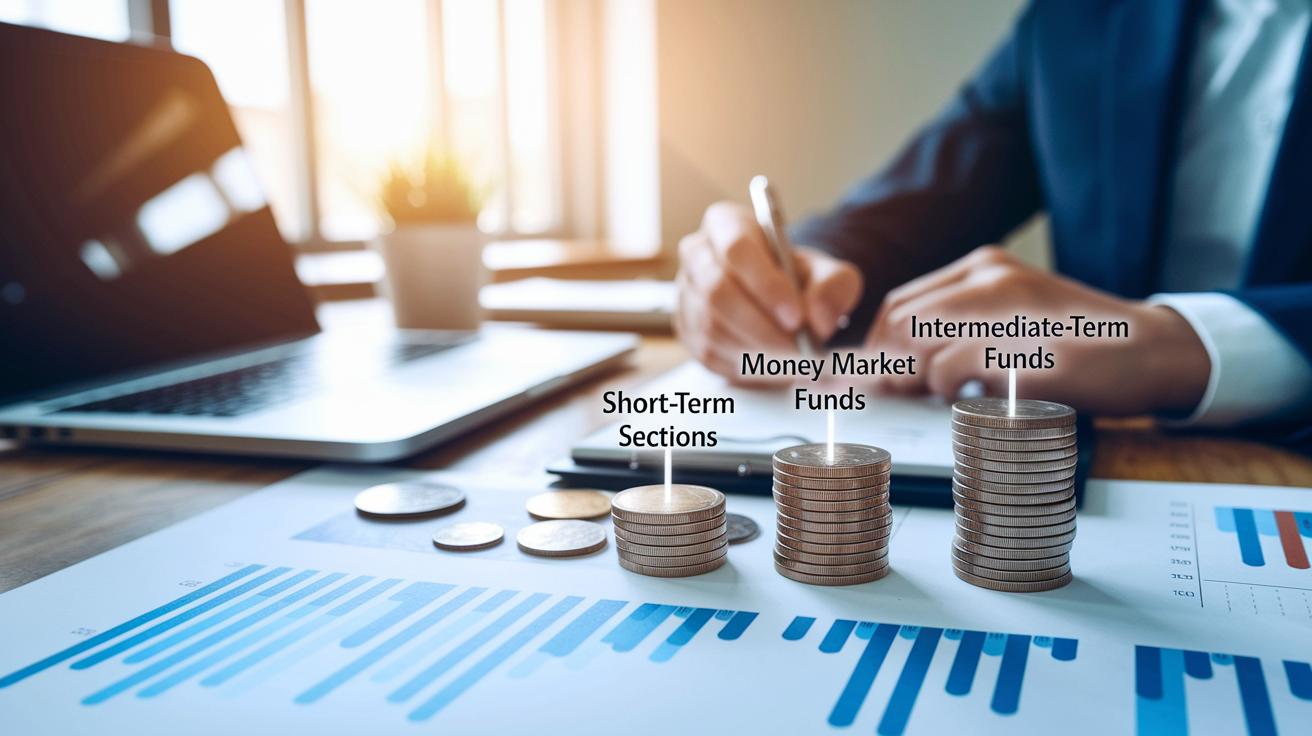
When it comes to a fixed income portfolio, short-term bond funds, money-market funds, and intermediate-term bond funds each play their own part. Short-term bond funds, for example, aim to blend stability with modest income. They’re similar to ultra-short bond ETFs, which invest in solid corporate bonds and money-market instruments so you can get a little yield boost while keeping your capital safe.
Money-market funds, on the other hand, are all about protecting your money. They deliver lower returns because they focus on capital safety, which means very little risk. Then there are intermediate-term bond funds. These invest in bonds with longer maturities, so while you might enjoy higher yields, you're also a bit more exposed to interest rate swings.
Here’s a simple breakdown to help you decide which might work best for your needs:
- Investment objectives: Short-term funds mix safety and income, money-market funds put capital preservation first, and intermediate-term funds are for chasing higher yields.
- Duration: Short-term funds hold bonds that mature in under five years, money-market funds target very short-term maturities, and intermediate-term funds include bonds with longer timelines.
- Yield range: Money-market funds generate lower returns, short-term funds provide moderate income, and intermediate-term funds aim for higher yields.
- Volatility: Money-market funds stay very stable, short-term funds have only slight fluctuations, and intermediate-term funds are more sensitive to interest rate changes.
- Credit mix: Money-market funds typically hold government and top-notch securities, short-term funds offer a mix of corporate and government bonds, and intermediate-term funds might cover a broader range of credit types.
- Liquidity: All three options let you access your funds fairly quickly, though money-market funds are designed for the fastest access.
Understanding these differences can help you pick a debt instrument that matches your risk comfort and income goals, ensuring your investment strategy works as hard as you do.
Fee Structures and Expense Considerations in Short-Term Bond Funds
Short-term bond funds usually keep their fees pretty low, generally between 0.05% and 0.30%. Keeping costs down means that your net yield stays close to the fund’s overall performance. You’ll often find that passive ETFs in this area have ultra-low fees, a big plus for investors who want to hold onto every bit of their yield. But if you choose an active mutual fund, you might pay a bit more to cover expert credit selection and hands-on management. Even a slight difference in fees can really stretch out over the long haul, so it’s worth taking a moment to compare your options.
When you’re looking at fee structures, keep these points in mind:
- Expense ratio: This is the yearly fee charged as a percentage of your investment.
- Load: These are the sales charges or commissions you might encounter.
- Redemption fees: Costs that come into play when you sell your shares.
- Tracking error: This measures the difference between the fund’s return and that of its benchmark.
Market Conditions and Interest Rate Impact on Short-Term Bond Funds

Short-term bond funds, those with durations under one year, tend to feel only a gentle nudge from Fed policy changes. When the Fed shifts rates, these funds can quickly reinvest maturing bonds at the new yields instead of getting stuck with long-term coupons. In a scenario where rates are on the rise, funds benefit from higher yields on those reinvested bonds, but when rates fall, new issues might offer lower coupons, reducing overall income. This behavior becomes even more significant when you look at the broader economic picture, which can influence credit markets. For a clearer picture of what lies ahead, checking out the US economic outlook can offer useful hints about expected rate moves.
- In rising-rate scenarios, reinvested bonds tend to earn better yields, even if prices don’t change much.
- When rates drop, new issues often come with lower coupons, which can cut income potential.
- Under stable-rate conditions, funds enjoy a consistent income with minimal market swings.
Spreads, essentially the difference in yield between corporate bonds and similar government securities, also play a crucial role. When these credit spreads are tight, they often signal healthy economic conditions, potentially boosting income for funds that invest in corporate bonds. On the flip side, if the spreads widen, it could be a sign of rising credit risks, and that might slightly dampen performance even in these low-duration funds.
Expert Strategies for Selecting and Allocating Short-Term Bond Funds
Building a short-term bond portfolio might seem puzzling at first, but laddering can really simplify things. Instead of locking all your bonds into just two separate periods, laddering means spreading them out with maturities ranging from 6 to 36 months. This way, you get bonds maturing at regular intervals, making it easier to handle volatile market conditions and take advantage of shifting rates. It’s like having a steady stream of opportunities, securing income now and giving you a chance to reinvest at potentially better yields later.
Credit-Selection Criteria
When choosing bonds, active credit selection plays a crucial role. This approach focuses on picking bonds from issuers with high-quality ratings, basically companies known for their stability. You want to look for investment-grade thresholds and perform spread analysis, which is really just comparing extra yield to the added risk. Managers lean towards issuers with improving fundamentals to help boost yields without taking on too much risk.
A smart strategy for a robust portfolio is to mix low-fee passive ETFs with a few active funds that dig deep into credit evaluations. Passive options provide broad market exposure while active funds add a layer of detailed insight. This combination not only enhances your yield potential but also spreads your investments across different issuers, sectors, and credit qualities, giving your portfolio a solid buffer against unpredictable market shifts.
Final Words
In the action, we explored what short term bond funds are and how their different maturity ranges serve various investor needs. You learned about fee structures, market conditions, and expert strategies for selecting these assets. Each section offered clear insights into balancing income generation with capital preservation. With a solid understanding of these funds, you're in a stronger position to make smarter budgeting and investing decisions. Keep experimenting with these concepts and enjoy the positive momentum of well-informed financial planning.
FAQ
What is a short-term bond fund?
The short-term bond fund is a mutual fund or ETF that invests in bonds maturing in under five years, aiming to deliver income and preserve capital while reducing exposure to interest-rate swings.
How do short-term bond funds work?
The short-term bond funds work by investing in bonds with near-term maturities, which limits interest-rate sensitivity and offers liquidity, yielding moderate returns suitable for investors with shorter time horizons.
What are some of the best short-term bond funds and ETFs?
The best short-term bond funds often include options like Vanguard Short-Term Bond funds, Fidelity Short-Term Treasury Bond Index Fund, Schwab’s 1-5 Year Corporate Bond ETF, and SPDR Portfolio Short-Term Corporate Bond ETF, each providing a stable mix of income and safety.
Are short-term bonds a good idea for investors?
The short-term bonds prove to be a good idea for investors aiming for 3-5 year goals, as they deliver lower volatility, moderate yields, and a focus on capital preservation compared to longer-term alternatives.
What are notable opinions on short-term bond funds from platforms like Reddit?
The sentiment on platforms like Reddit points to short-term bond funds as dependable, with many investors appreciating their balance of income generation and risk control, making them a preferred choice for conservative portfolios.
How do offerings from Fidelity, Schwab, and Vanguard compare in short-term bond funds?
The offerings from Fidelity, Schwab, and Vanguard share a common focus on low-duration investments but differ in fee structures, yield expectations, and management styles, providing investors various pathways to meet their risk and return preferences.
Which bond pays 7.5% interest?
The mention of a bond paying 7.5% interest is not directly covered here; short-term bond funds typically aim for modest yields, so check specific bond listings or consult an advisor for exact yield details.